
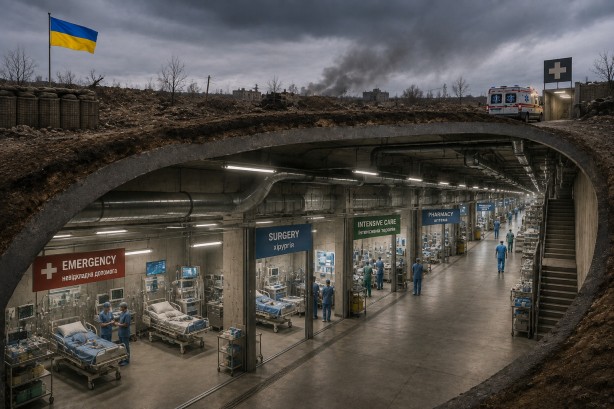
A Dutch foundation has unveiled plans to construct what it claims will be the largest underground hospital in Ukraine, strategically positioned near the front lines to offer emergency medical care while safeguarding both patients and medical personnel from the dangers of drone and artillery strikes. The facility, spanning around 600 square meters, will be situated roughly 8 meters below the surface. Its robust reinforced concrete structure is engineered to endure intense bombardments. The hospital will be equipped with six operating rooms designed for urgent trauma care, including surgeries for shrapnel injuries and the administration of blood transfusions.
This underground hospital is not intended for long-term patient care but will function as a stabilization center. It will enable critically injured soldiers to receive immediate surgical intervention before being transported to medical facilities located further from the combat zone. In a move to maintain security, the precise location of the facility is being kept confidential. Preparations for construction have already commenced, with the hospital slated to become operational by February 2027.
The initiative was prompted by a request from Ukraine’s Military Medical Service and is being executed with assistance from a Norwegian healthcare foundation. The estimated cost of constructing the underground complex is projected to be €2 million. An additional €500,000 will be required for acquiring medical equipment, supplies, and armored vehicles necessary for patient evacuation. Consequently, the total financial requirement for the project is expected to be around €2.5 million. To date, the foundation managing the project has secured approximately €750,000 and is actively seeking an additional €1.75 million to reach its funding goal.
Project coordinators emphasize the growing necessity of such protected medical facilities in close proximity to combat zones. The prevalent use of drones in battlefield operations has increasingly complicated traditional evacuation processes, thereby heightening the importance of having secure medical centers near the front lines. This development underscores the ongoing challenges faced by medical services in conflict regions and their continuous efforts to adapt to evolving warfare tactics.